Working to build a just society where human rights are respected, human dignity is protected, human development is facilitated and the environment is respected and protected.

HSE Service Plan reveals Government's failure to address core challenge

The HSE's Service Plan for 2010 reveals the HSE's targets for hospital, community and primary care services.  The failure of Government (not the HSE) to support the initiatives required to provide a comprehensive network of primary care teams across the country means that the healthcare system will continue failing to provide the core structural development required. A close reading of this Service Plan suggests Government is continuing its drive to privatise large parts of the healthcare system.

Anger at European Commission's misrepresentation of views on its draft strategy for 2020

Social and environmental organisations have reacted angrily to claims by the European Commission that they "broadly support" draft plans for the EU's Strategy 2020. The European Commission has published a first overview of the public consultation on the EU 2020 Strategy, together with an evaluation of the Lisbon strategy. This overview misrepresents the views of major networks of organisations working with those who are poor and excluded across the EU. In turn this misrepresentation calls into question the commitment of the Commission to develop an acceptable strategy for 2020; it also call into questions the willingness of those involved to give serious consideration to views other than their own.

EU Year Against Poverty needs more than rhetoric from the Irish Government and the EU

Social Justice Ireland believes that the Irish Government’s launch of its plans for the EU Year against Poverty and Social Exclusion is more rhetoric than real commitment. This can be seen in Government’s failure, among other things, to address the large regional differences in the levels of poverty. Government has an anti-poverty strategy, a spatial strategy and a commitment to balanced regional development but all are failing to address regional disparities in poverty. The latest statistics on poverty show that 9.3% of Dublin’s population is in poverty compared to 22.7 in the Midlands region.

Government and EU challenged to adopt ‘zero poverty’ as target for 2020.

 
Social Justice Ireland has challenged Government to adopt a target of ‘zero poverty’ by 2020. In its most recent Policy Briefing, Social Justice Ireland states that “Government needs to change direction in its approach to reducing poverty. A good starting point would be for Ireland and the EU to adopt a target of ’zero poverty’ to be reached by 2020.” This would be a very appropriate way of marking the European Year against Poverty and Social Exclusion. There are almost 615,000 people at risk of poverty in Ireland. Almost 200,000 of these are children; 116,000 are employed (these are the ‘working poor’). All of these numbers are extremely disturbing.

Social Justice Ireland's Policy Briefing on Poverty - full text

The full text of Social Justice Ireland's Policy Briefing on Poverty is available here.

8 Irish MEPs attend launch of Zero Poverty Campaign in Brussels

8 Irish MEPs attended the launch of Caritas Europa's 'Zero Poverty Campaign' in the European Parliament. This campaign is being conducted in all 27 EU countries to coincide withthe European Year Against Poverty and Social Exclusion.

Haiti's debt should be cancelled now - Oireachtas Committee supports call

As the dreadful reality of what is happening in Haiti receives extensive coverage in the media an even more shocking reality is not being reported for the most part: as aid flows in to Haiti's desperate communities, money is flowing out to pay off the country's crushing debt - close to $1 billion in unfair debt racked up years ago by unscrupulous lenders and governments. The Oireachtas (Parliamentary) Committee on Foreign Affairs has supported this call and Social Justice Ireland welcomes their initiative.

Poverty is a scandal - Zero Poverty Campaign launched

Poverty is a scandal. What else can it be when more than half a century after the establishment of the EU (in its earlier incarnation) 17% of all those in the EU live in poverty. 20% of children in the EU are at risk of poverty. The comparable figures for Ireland are 13.8% and 18%. As part of its action for the European Year 2010 for Combating Poverty and Social Exclusion, Caritas Europa launched its Zero Poverty campaign for the at the European Parliament in Brussels. The central message of this campaign is that poverty is unacceptable in the 21st century. Social Justice Ireland is the Irish organisation working within the Caritas Europa network on this campaign and related issues.


Economic crisis is also a crisis of ethics - Davos poll

More than two thirds of people believe the current economic crisis is also a crisis of ethics and values, according to a World Economic Forum (WEF) opinion poll. The poll draws on responses from more than 130,000 people from 10 G20 economies on Facebook. When asked to identify the values most important for the global political and economic system, almost 40% chose honesty, integrity and transparency; 24% chose others’ rights, dignity and views; 20% chose the impact of actions on the well-being of others and 17% chose preserving the environment.

European Commission's strategy for the EU until 2020 is deeply flawed

 
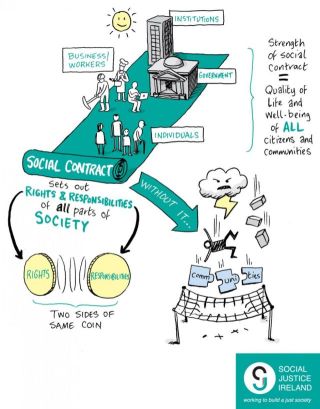
The European Commission's strategy for the EU until 2020 is deeply flawed and would not be acceptable under any circumstances as a meaningful basis on which to proceed to articulate a vision to guide the EU in the coming decade. In a submission to the Commission, Social Justice Ireland has argued that: “the vision outlined in the Commission’s working document only contains very superficial ‘social’ content.”  It sees the EU as a social market economy. However smarter and greener such an economy may be, focusing on the economy alone leads to a fundamental failure to appreciate that economic and social development are two sides of the one coin. Economic development must be accompanied by social development and environmental protection if we are to have a genuinely inclusive, viable and sustainable future for the European Union.

European Anti-Poverty Year launched - mixed reception

 On January 21, 2010 the European Year Against Poverty and Social Exclusion was officially launched in Madrid under the Spanish presidency of the EU. One of the most noteworthy outcomes from the opening conference, was a joint call from the Belgian and French secretaries of state for quantified EU targets to reduce poverty by 2020 (and to make them as binding as the Stability and Growth Pact). This was one of the initiatives that Social Justice Ireland called for in its Submission to the European Commission on their consultation document on the EU Strategy for 2020.

Poor Can't Pay Campaign Budget Analysis shows poor hardest hit

The Poor Can't Pay Campaign has published an analysis of Budget 2010 entitled 'How the Poor Were Made to Pay' which shows that the cuts introduced by Government will impact hardest on the poorest in society and will push thousands of families into poverty in the coming months. The campaign, which is a coalition of charities, community organisations and trade unions, has called on the Taoisesach to give an immediate assurance that there will be no more cuts in social welfare payments and no cut in the minimum wage.

What are the facts on NAMA?

There is much contradictory and very confusing comment on what the facts really are concerning NAMA.  Here we list and link to a number of sources that readers may find of help as they try to discover the facts about NAMA.

€7billion gift to banks likely to undermine State’s finances and public services for years to come while failing to secure credit for businesses

Social Justice Ireland statement on NAMA and related issues.

Department of Finance publishes analysis of replacement rates for unemployed people

On December 4, 2009 the Department of Finance published an analysis of replacement rates for unemployed people. The full text is available here.

Government must protect the vulnerable says Community and Voluntary Pillar of Social Partners

The 17 Social Partner groups in the Community and Voluntary Pillar of social partnership have jointly expressed serious concerns about the lack of protection for the vulnerable in our society, in Government plans for national recovery.

Text of Commission on Taxation Report

 The Report of the Commission on Taxation was published on September 7th, 2009. The full text of the report may be read here.

Renewed Programme for Government - Full Text

The full text of the renewed Programme for Government published on October 10, 2009 is available here

Bord Snip Nua Report - full text

The Bord Snip Nua report volume one can be accessed here.   Volume 2 of the report can be accessed here.

Bord Snip disproportionately targets those who are poor or sick or older or vulnerable

The cuts in expenditure proposed in the Bord Snip report are focused disproportionately on people who are poor or sick or older or vulnerable in some way. Cuts in welfare rates and in many services will mean that those who are vulnerable will bear the brunt of Government's attempts to balance its budget. 

Social Justice Ireland recognises full well that the country's finances are in bad shape and need to be rectified. However, Ireland is in this situation because of the activities of bankers, politicians, speculators, developers and many economists. Who should pay for the misdeeds of these people? The authors of the Bord Snip report provide a clear answer: from their perspective the vulnearable, the disadvantaged and those living in remote communities should be the hardest hit!  Social Justice Ireland rejects this conclusion totally.

Recent Publications from Social Justice Ireland

  • Analysis and Critique of Budget 2010.  Full text available here
  • Beyond GDP: What is progress and how should it be measured.  Full text and individual chapters available here
  • Social Justice Ireland's detailed proposals for Budget 2010.  Full text available here
  • Policy Briefing on Budget Choices.  Full text available here

Unfair, unjust Budget fails the vulnerable, damages the economy

The full text of Social Justice Ireland's Analysis and Critique of Budget 2010 is available here
The unfair and breathtakingly unjust decisions made in Budget 2010 will damage Ireland’s economic development and social development.
This Budget is anti-family, anti-poor and anti-children. Government chose to reduce the income going to large numbers of Ireland’s poorest people while wasting money on a useless scrappage scheme that will have no significant impact on emissions but will see most of the money going to overseas manufactures.
In what appears to be an ideologically fixated approach to Budget 2010 Government has placed its faith in the failed neo-liberal economic model which caused many if not most of the current economic problems not just in Ireland but across the world.

Beyond GDP: What is progress and how should it be measured? - Full texts

Social Justice Ireland's new publication addresses the topic Beyond GDP: What is progress and how should it be measured?  The full text of the book and the individual chapters are available through the links below.
Beyond GDP: What is progress and how should it be measured? - complete book
 
Individual chapters can also be accessed.

Social Justice Ireland challenges Ireland’s benchmarking of itself beside Romania, Slovakia, Latvia, Lithuania and Estonia

 
Producing a fair budget and working for a fairer future requires that Ireland stop benchmarking itself with Romania, Slovakia, Latvia, Lithuania and Estonia. Social Justice Ireland has pointed out that Ireland and these countries take the lowest proportion of national income in tax in the EU, have the lowest total-Government expenditure and have the lowest social expenditure in the EU. In fact Ireland’s total tax take has fallen as a proportion of GDP since the start of the present economic crisis – from 31.4% to 27.4% of GDP and is now among the lowest in the EU.

Ireland should re-commit to overseas aid target for 2012

 
Social Justice Ireland  believes that Ireland’s overseas aid budget should not be reduced any further. In the context of Ireland’s current challenges it is important to bear in mind that many people in the world are in a far worse situation and have been in this situation for a very long time. Ireland and other countries in the better-off part of the world should not abandon the world’s poorest at this crucial time.

Total tax-take needs to change - article in Irish Examiner by Director of Social Justice Ireland

 The Government can meet its budget expenditure cuts without reducing social welfare payments or the minimum wage.

Commission on Taxation produces mixed set of proposals

The Report of the Commission on Taxation, published on September 7, 2009, has produced a wide range of proposals. Some of these are very positive others are not acceptable. 

Eurostat finds Ireland's prices second highest in Europe

Prices in Ireland over 2008 were found to be the second highest in Europe. That’s the main finding of a Eurostat survey of consumer price levels in 2008 released earlier today. The figures are taken from a basket of goods including food, alcohol and tobacco, clothing, consumer electronics, personal transport equipment and hotels and dining out.

OECD says Ireland’s short-term labour market outlook remains grim

Despite signs that the recession is slowing in Ireland as well as in many other countries, the short-term labour market outlook remains grim according to the OECD. In its Employment Outlook 2009, published on September 16, 2009, it states that latest OECD projections indicate a further decline in economic activity in Ireland in 2009, with a muted recovery surfacing only in 2010.

OECD warns 57 million people could be unemployed in better-off countries – calls for major Government action

 
Unemployment in better-off countries could reach 10% of the labour force if the economic recovery fails to gain momentum according to the Organisation for Economic Co-operation and Development (OECD). This would bring the total number unemployed in these countries to 57 million. It has already reached 8.5%, an increase of more than 15 million in the numbers unemployed since the end of 2007.  

NESC Report on Well-Being - published October 6, 2009

An integrated and balanced approach, which takes into account the well-being of individuals and of society, is required in responding to the economic crisis’ according to the National Economic and Social Council (NESC). In its recent report NESC argues that economic and social progress are complementary, so that social well-being is a central element in economic recovery.

GDP seen as a poor measure of progress by Nobel economists Stiglitz, Sen and others

Standard measures of economic performance must be overhauled to reflect “well-being” and to help policy-makers address financial instability and climate change according to a major new study prepared by a Commission headed by two Nobel laureates in economics, Joseph Stiglitz and Amartya Sen. 

New Encyclical emphasises importance of the common good

Fixing the Economy by Focusing on Ethics

A new encyclical has been published calling for a new business order governed by ethics and the common good. In the encyclical letter entitled Charity in Truth (Caritatis in Veritate) Pope Benedict XVI's main message is that various "malfunctions" have taken place in the economy which are threatening human development in all its various forms. He points out that the current turmoil in world economies is being caused by a blind pursuit of profit and that our various social institutions have shifted their focus away from protecting people towards the narrower focus of profit.

Seán Healy and Brigid Reynolds to head Social Justice Ireland

 Fr Seán Healy, S.M.A. and Sr Brigid Reynolds, S.M. are to lead Social Justice Ireland.   This organisation will take over the programmes and projects run in recent decades by CORI Justice including its social partnership role.