
Demographic projections and implications for policy

Future Forty Demographic trends examines the forces driving population shifts in Ireland. The report outlines how demographic trends will significantly impact Ireland’s economic and fiscal position over the long-term. An increasing old-age dependency ratio increases pressure on public finances, with rising costs for pensions, healthcare, and social services. Over the long-term, a smaller workforce relative to the total population will pose fiscal challenges and potentially constrain economic growth. Accurate population projections are crucial for effectively planning for future infrastructure and service demand.
Overview of demographic trends
The report details how the effects of demographic trends are already in motion. Ireland’s old age dependency ratio139 has risen from 18.2 per cent in 1984, to 23.1 per cent in 2022. Over the same period, the fertility rate141 fell from an average of 2.6 births per woman to 1.53 births. A rising old-age dependency ratio increases pressure on public finances, by raising costs for age-related expenditure. Over the long-term, a smaller workforce relative to the total population will pose fiscal challenges and potentially constrain economic growth.
Migration flows, both inward and outward, will also have an acute impact on Ireland’s long-run economic and fiscal position. Inward migration can help to offset demographic challenges by boosting the working-age population, filling critical skills gaps and supporting sectors experiencing labour shortages - in turn promoting economic growth, innovation and productivity. However, a significant increase in net migration also poses challenges - particularly in ensuring that public services, housing and infrastructure can keep pace with demand. Increased demand for public services may also compound delays in family formation and lower birth rates.
Globally, the flow and scale of international migration is reaching levels not seen in decades, with overall global migration figures at unprecedented levels. Net migration in Ireland has been highly volatile over recent decades, closely reflecting fluctuations in the economic cycle.
Methodologies for estimating a range of future population levels can support the development of useful economic and fiscal projections. Of the three key determinants of population (births, deaths, migration), migration is the most influential, as well as the most volatile. Therefore, migration assumptions are highly consequential to the overall outcome of any future scenario.
Population projections
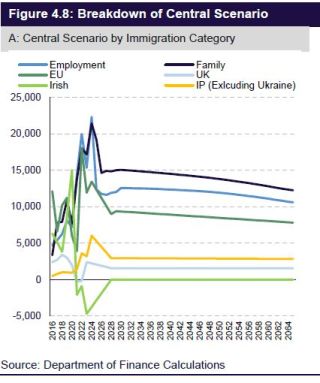
The report uses a ‘Central Scenario’ to project demographic trends to 2065. In the Central Scenario net migration ranges between 35,000–40,000 with Ireland’s population reaching 6.77m in 2065, with labour force growth sustained until 2047. In the Central Scenario, employment-based migration is expected to continue to account for a high share of overall migration over the time horizon. In reality, this share may change over time given the nature of labour shortages in the economy.
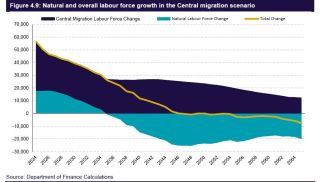
In this scenario net migration becomes the sole driver of labour force growth in the long run. While natural labour force growth gradually declines and turns negative from 2035 onwards, medium levels of net migration offset this trend ensuring that overall labour force growth remains positive until 2047. This trend reflects an increasing reliance on net migration to meet labour demands. Even in the shorter-term, up to 2030, net migration is expected to constitute approximately three-quarters of labour force growth. The implications of this are significant: without sufficient net migration, labour and skills shortages may be exacerbated, especially post-2035 when natural labour force growth turns negative.
Demographic Trends poses a number of considerations for policymakers. Firstly, the emigration rate for certain migrant categories, such as Critical Skills Employment Permit Holders are relatively high, posing challenges from a fiscal, workforce and integration perspective. This points to the need for contingency plans to better prepare for higher migration outcomes, to avoid potential bottlenecks. Ensuring provision of services and infrastructure keeps pace with demographic trends is essential for maintaining Ireland’s appeal and driving living standard growth. Finally, the report notes that there are significant data limitations when it comes to understanding and forecasting migration trends in Ireland. The report recommends that development of an integrated cross-departmental data system should be considered to allow for granular, real-time analysis.
The interaction between migration and fertility will shape Ireland’s population growth in the coming decades. It is clear from this analysis that migration is the greater determinant of overall population levels, with changes in the fertility rate having a more modest impact. While fertility rates tend to change gradually, migration flows can be more volatile, driven by a complex mix of internal and external economic, political and environmental factors.
Old Age Dependency Ratio
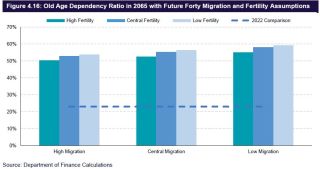
Over the past 40 years, Ireland’s old-age dependency ratio has increased from 18.2 per cent in 1984 to 23.1 per cent in 2022. In all migration and fertility scenarios, there will be a significant increase in the population aged over 65, as well as a fall in the number of persons aged 0-19. This research has highlighted that there are significant data limitations when it comes to understanding and projecting migration trends.
Ireland has experienced rapid population growth in recent years and, under both high and Central Scenarios presented in this analysis, this trend would continue. These estimated increases in population will impact on demand for public services, infrastructure and housing. Ensuring infrastructure and housing development keeps pace with demographic trends is essential for maintaining Ireland’s appeal as a destination for highly skilled international talent. In this context, state bodies should contingency plan for higher demographic outcomes to ensure readiness and adaptability if such an outcome were to arise.
This research has also found that Ireland’s old-age dependency ratio will rise significantly over the coming decades (from 23.1 per cent in 2022, to 55.2 per cent in 2065, under the Central Scenario). This will place significant pressure on public finances, pensions and healthcare services. Continuing to enhance the management of migration can help sustain a larger working-age population, alleviating some of the pressures from these demographic shifts. In addition, proactive policy measures to future-proof Ireland’s pension and healthcare system will be essential in ensuring long-run economic stability.
Policy considerations
Social Justice Ireland welcomes the projections contained across Future Forty. This is the type of data and analysis required to inform Government policy to build a better Ireland. This work must start with a discussion on how we can build strong and sustainable public finances now, and plan for our revenue and expenditure needs into the future.
Our demographics are changing, we are living longer which is a huge success story. Now is the time to plan for this success story, to build on it, and ensure that we use our economic success to provide the services and infrastructure that people need now, and into the future. Ireland needs to have a real debate about the levels of services and infrastructure it wishes to have in the coming decades, and how these are to be financed.
We need to plan now for resourcing the future, and we must be clear about what types of services and infrastructure deficits exist that need to be addressed and resourced immediately, and how these are to be funded. We also need to be clear about what types of services and infrastructure people and communities need and expect in the future, how much this will cost and how this will be funded on an annual basis. Regardless of what levels of services and infrastructure are agreed upon, one thing is absolutely clear, the proportion of revenue that we collect will have to increase in years to come, and our tax take will have to increase. Ireland can achieve this in a fair and equitable manner. Partly by reforming the tax code and broadening the tax base and making sure that those who benefit the most from Ireland’s economic system contribute the most.
Social Justice Ireland believes that, over the period ahead, policy should focus on increasing Ireland’s tax-take. Previous benchmarks, set relative to the overall proportion of national income collected in taxation, have become redundant following recent revisions to Ireland’s GDP and GNP levels as a result of the tax-minimising operations of a small number of large multinational firms. Consequently, an alternative benchmark is required. We have proposed a new tax-take target set on a per-capita basis; an approach which minimises some of the distortionary effects that have emerged in recent years. Our target is calculated using CSO population data, ESRI population projections, and CSO and Department of Finance data on recent and future nominal overall taxation levels. This should be the first step towards planning for a sustainable tax take and developing a broad tax base.