
Earth's climate increasingly out of balance

The Earth’s climate is more out of balance than at any time in observed history, as greenhouse gas concentrations drive continued warming of the atmosphere and ocean and melting of ice. The World Meteorological Organisation's State of the Global Climate report 2025 confirms that 2015-2025 are the hottest 11-years on record, and that 2025 was the second or third hottest year on record. Extreme events around the world, including intense heat, heavy rainfall and tropical cyclones, caused disruption and devastation and highlighted the vulnerability of our inter-connected economies and societies.
Greenhouse Gases
Data from individual monitoring stations show that levels of three main greenhouse gases – carbon dioxide, methane and nitrous oxide – continued to increase in 2025. In 2024 – the last year for which we have consolidated global observations - the atmospheric concentration of carbon dioxide reached its highest level in the last 2 million years, and methane and nitrous oxide in at least last 800,000 years.
The increase in the annual carbon dioxide concentration (CO2) in 2024 was the largest annual increase since modern measurements began in 1957. This was driven by continued fossil CO2 emissions, and reduced effectiveness of land and ocean carbon sinks.
Global mean near-surface temperature
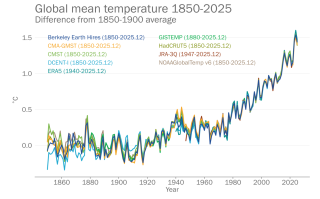
The past eleven years, 2015–2025, were the eleven warmest years on record. 2025 was the second or third warmest year (depending on the dataset) in the 176-year observational record, reflecting the shift to La Niña conditions that temporarily cool the planet. The annually averaged global near-surface temperature was about 1.43 ± 0.13 °C above the 1850–1900 pre-industrial average. The year 2024 – which started with a strong El Niño - remains the warmest year, at about 1.55 °C above the 1850–1900 average.
Ocean heat content
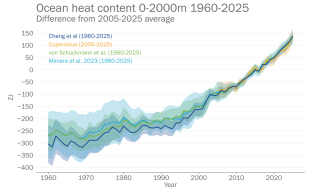
In 2025, ocean heat content (to a depth of 2,000 metres) reached the highest level since the start of records in 1960, exceeding the previous high set in 2024. Over the past nine years, each year has set a new record for ocean heat content.
Ocean heat content reached a new record high in 2025 and its rate of warming more than doubled from 1960-2005 to 2005-2025. Despite La Niña conditions, around 90% of the ocean surface area experienced at least one marine heatwave in 2025.
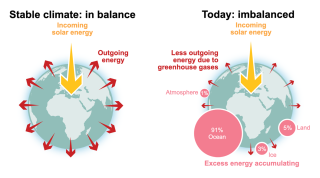
Ocean warming has far-reaching consequences, such as degradation of marine ecosystems, biodiversity loss and reduction of the ocean carbon sink. It fuels tropical and subtropical storms and exacerbates ongoing sea-ice loss in the polar regions. More than 91% of the excess heat being generated is stored in the ocean, which acts as a major buffer against higher temperatures on land. Another 3% of the excess energy warms and melts ice. The ice sheets on Antarctica and Greenland have both lost significant mass and the annual average Arctic sea-ice extent for 2025 was the lowest or second lowest on record in the satellite era. Exceptional glacier mass loss occurred in Iceland and along the Pacific coast of North America in 2025.
The warming ocean and melting ice are driving the long-term rise in global mean sea level, which has accelerated since satellite measurements began in 1993. Ocean warming and sea level rise will continue for centuries, according to projections by the Intergovernmental Panel on Climate Change (IPCC). Changes in ocean warming, and deep ocean pH are irreversible on centennial to millennial time scales.
Earth's Energy Imbalance
The Earth’s energy balance measures the rate at which energy enters and leaves the Earth system. Under a stable climate, incoming energy from the sun is about the same as the amount of outgoing energy. However, increasing concentrations of heat-trapping greenhouse gases - carbon dioxide, methane and nitrous oxide - to their highest level in at least 800,000 years have upset this equilibrium. The Earth’s energy imbalance has increased since its observational record began in 1960, particularly in the past 20 years. It reached a new high in 2025. Human activities are increasingly disrupting the natural equilibrium and we will live with these consequences for hundreds and thousands of years. The warming of the atmosphere including near the Earth’s surface (the temperatures that humans feel) represents just 1% of the excess energy, whilst about 5% is stored in the continental land masses.
In 2025, the observed Earth energy imbalance (EEI) reached the highest value since the observational record began in 1960 (Figure 9a). Since 1960, heat has been accumulating in the Earth system, in the ocean, atmosphere, on land and in frozen regions of the planet, driven by a growing imbalance in the Earth’s energy budget. As a result of the growing imbalance, the total amount of heat stored on Earth is not just increasing but accelerating.
Extreme Events and Impacts
The report details how our weather has become more extreme. In 2025, heatwaves, wildfires, drought, tropical cyclones, storms and flooding caused thousands of deaths, impacted millions of people and caused billions in economic losses. Extreme weather has cascading impacts on agricultural production. Climate-driven food insecurity is now seen as a risk, with cascading effects on social stability, migration and biosecurity through the spread of plant pests and animal diseases. It also continues to drive new, onward and protracted displacement of people globally, with particularly severe consequences in fragile and conflict-affected regions. The cascading and compounding impacts of multiple disasters severely limit the ability of vulnerable communities to prepare for, recover from and adapt to shocks.
Climate and heat impacts on health
Climate change has wide-ranging impacts on mortality, livelihoods, ecosystems and health systems and amplifies risks such as vector- and water-borne diseases and mental health stressors, especially among vulnerable populations. Dengue stands out as the world’s fastest-growing mosquito-borne disease. According to the World Health Organization, about half the world’s population is at risk and reported case are currently the highest ever recorded.
Heat stress is a growing problem. Over one-third of the global workforce (1.2 billion people) face workplace heat risk at some point each year, especially those in agriculture and construction. In addition to health impacts, this leads to productivity and livelihood losses. As of 2023, only around half of countries provide heat early warning services tailored to the needs of the health sector, and even fewer have fully integrated climate information into health decision-making processes.
Social Justice Ireland view
It is clear that extreme weather events are having a global and national impact. The impact of recent storms and flooding have highlighted how vulnerable we are to the impacts of climate change. Increased investment and a rapid scaling up of adaptation measures is required, alongside flood defences, localised weather warning systems and improved regional infrastructure resilience. Our poor implementation of climate policy to date has exposed just how vulnerable we are to the impacts of our changing weather.