
Future Forty: Climate Change and the Green Transition

Future Forty, as part of its long term analysis, examines the potential long term impact of climate change and the green transition on Ireland’s economy and public finances in the years ahead. The report notes that long-term changes to Ireland’s existing climate, as well as the increased frequency of extreme weather events, will likely cause ongoing economic damage that will require a response from the State. The State will also face the continued cost of supporting the transition towards net-zero emissions, and maintaining a more sustainable economic model for future generations.
Future Forty: Climate Change and the Green Transition
The climate emergency will have major implications for the Irish economy, and for Irish public finances, over the next forty years. Some of the impacts are already being felt, as Ireland has already experienced a 0.9°C increase in annual average temperatures over the past 120 years, with notably warmer winters and higher precipitation levels since the mid-20th century. There has also been a 2-3mm rise in sea levels each year since the early 1990s.
As these trends continue or even accelerate, they will bring considerable economic and fiscal challenges. Changes to Ireland’s climate (such as warmer temperatures, changing rainfall patterns and rising sea levels) will generate adaptation costs for many sectors of the economy, as well as for the exchequer. Furthermore, the anticipated increase in the frequency and severity of extreme weather events will cause significant damage and disruption which will require a financial response from the State.
Beyond the direct impacts of global climate change, there will also be indirect impacts arising from the reduction of fossil-fuel usage and the transition towards a more sustainable economic model. Ireland is committed under domestic legislation to a 51 per cent reduction in greenhouse gas emissions (from 2018 levels) by 2030, and to reaching net-zero emissions by 2050. However, Ireland will need to accelerate its green transition in order to achieve these targets. From a fiscal perspective, the required reduction of emissions could prove challenging, as much of the investment into infrastructure and emission-intensive sectors will be sourced from the State. These publicly funded investments will be developed in the context of reduced exchequer revenue from carbon-based fuel levies, due to the planned reduction in their usage.
Future economic impact
According to the report, the future economic impact of a changing climate is extremely difficult to predict, as uncertainty remains with regards to the exact relationship between global greenhouse gas emissions, subsequent climatic changes and the response of the global economy. Despite this uncertainty, climate change will almost certainly affect many sectors of Ireland’s economy, with some impacted more than others:
- The risk of flooding and rising sea levels pose a threat to all sectors of the economy, especially for businesses and workers based in areas most prone to flooding.
- Ireland’s national infrastructure is at risk of increased damage and decay due to climate change and related extreme weather events. Although this will bring general negative impacts for the economy, sectors which are most dependent on this infrastructure will be most exposed.
- Extreme weather events, along with broader shifts in the country’s climate, will likely inflict pressure on the existing agriculture and natural resource sectors. However, climatic shifts may also present opportunities for some within these sectors, as Ireland may become relatively more suitable for certain types of activities. The scale and the distribution of these costs and opportunities remains to be seen.
- Rising temperatures associated with climate change could reduce the productivity of Ireland’s labour force, especially amongst workers most exposed to weather conditions.
- Similarly, there will be cross-sectoral implications from higher energy costs, if energy demand increases alongside rising temperatures. All households and businesses could face reduced purchasing power as a result, however energy-intensive industries are likely to be most affected by such price hikes. Climate change will also impact Ireland’s capacity to produce sufficient (renewable) energy to meet demand.
- Finally, shifts in the global economy, driven by climate change as well as related concerns surrounding national energy and food security, could damage the Irish economy due to its openness and exposure to international events.
It is highly likely that there will also be sizeable impacts on the economy from the movement away from fossil-fuels. The reduction of emissions will bring both challenges and opportunities, as many sectors will need to make significant adjustments to their production models, while some could also see growth.
Future Forty: Central Scenario
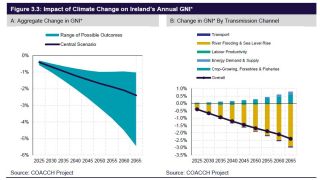
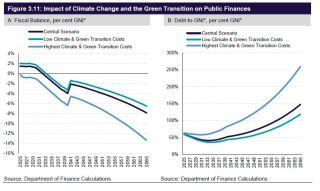
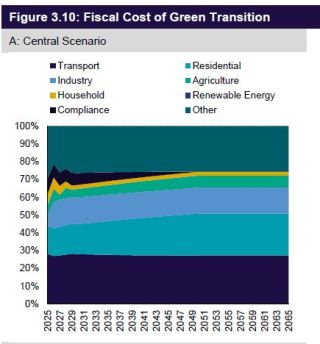
The impact of a changing climate on the Irish economy over the next forty years is estimated using the EU Co-Designing the Assessment of Climate Change Costs (COACCH) Project. The Central Scenario projects that climate change will reduce GNI* by over 2 per cent by 2065, with the majority of this damage caused by flooding and sea level rise. The associated cost to the exchequer would be around 1.2 per cent of GNI*, however it could reach as high as 1.8 per cent. More extreme Scenarios see damages reaching 3-4 per cent of GNI* by 2065. The additional cost to the exchequer from the green transition is projected to fall over time. The Central Scenario projects green transition costs to fall from 2 per cent of GNI* to just 1.2 per cent by 2065. Alternative scenarios explore higher and lower outcomes. Due to the scale of these impacts, climate change and green transition costs will have a significant impact on the overall fiscal position throughout the period.
Scenario 1: Central Scenario
The Central Scenario envisages ‘middle-of-the-road’ climate action around the world, which sees slow progress towards sustainability goals, albeit with environmental degradation continuing. It is assumed that the intensity of resource and energy usage will decline, whilst economic growth and progress will remain unequal. Global population growth is assumed to level off in the second half of the 21st century. These developments will be accompanied by an increase in average global temperatures of approximately 2.5°C above pre-industrial levels by the end of the century.
The pace of Ireland’s green transition beyond this decade is currently unknown, hence this analysis can only assess the cost of announced climate policies with accuracy. The EPA forecasts that Ireland’s Climate Action Plan will deliver 29 per cent emission reductions by 2030, well-below the national target of 51 per cent. If this gap-to-target is not addressed in the coming years, it will make the gap to net-zero even more considerable for the 2030s and 2040s.
Beyond 2030, there are significant policy gaps which make assessing long-term costs considerably more difficult.Climate change itself will have a considerable economic cost, and Ireland’s domestic green transition will likely have a limited effect on the scale of these costs. The Central Scenario in the COACCH project estimates that global temperatures will rise to (at least) 2.5 degrees above pre-industrial levels by the end of this century. Every 0.1C increase in temperature will have long term economic and fiscal impacts, and Ireland should make every effort to support global action to reduce emissions and address climate damage. More collective global action will be required to meet the goal of limiting warming to 1.5C by the end of century as agreed in the Paris Agreement 2015.
The results of this analysis indicate that Ireland can expect climate damages, in particular from river flooding and sea level rises. Ireland has a National Adaptation Framework, updated in 2024, which sets out roles for Departments and Agencies to strengthen adaptation and climate resilience. Attention must turn toward proactive rather than reactive measures to assess and address vulnerabilities, with a particular focus on strengthening flood defenses. Research which identifies areas and infrastructure most at-risk and most vulnerable should be expedited to allow for this proactive approach to adaptation.
It is clear, notwithstanding the challenges in projecting the direct and indirect impact of climate adaptation and the green transition beyond 2030, that Ireland faces substantial obstacles in preparing for the impacts of climate change on the economy. Swift policy implementation and action and large scale, upfront public investment in large infrastructure projects such as improved public transport infrastructure across the island (including in areas where services are limited), upgraded national grid capacity and storage facilities and preparing our social protection system now for the sectoral impacts that this change will have are key areas that must be progressed with urgency.