
An Alternative Wellbeing Framework for a Fairer Future

The Wellbeing Framework has become a valuable tool for guiding Ireland’s policy decisions. Each year, the Government of Ireland publishes a wellbeing report, Understanding Life in Ireland, to assess the quality of life across economic, social, and environmental domains. Our analysis in the previous article shows that the Government’s current approach treats the wellbeing framework as a high-level snapshot rather than a tool for identifying and understanding disparities. By leaving out equality and sustainability, the framework misses the issues that matter most for ensuring fair and lasting progress.
Social Justice Ireland’s alternative wellbeing framework aims to provide a comprehensive and more grounded picture by prioritising a set of indicators that reflect the lived experiences of different groups. The table below provides a snapshot of the key areas of progress, stagnation, and decline across the 11 wellbeing dimensions using this alternative set of indicators. Social Justice Ireland’s approach also restores equality and sustainability as core pillars of wellbeing measurement, and highlights areas where progress has been insufficient, inequitable, or unsustainable.
Performance is calculated based on a combination of percentage change over time (typically a five-year period, depending on data availability) and an international comparison of Ireland’s standing relative to the EU/OECD average and the best-performing country. Equality is measured as the relative percentage difference between the best- and worst-performing groups for each indicator; perfect equality equals to one, and values further away from one indicate greater inequality. This approach captures disparities across different demographic groups to assess whether progress is being shared equitably. Sustainability scores reflect progress for indicators that have been tagged as sustainability-related and are calculated using the same method as performance.
Overall Findings
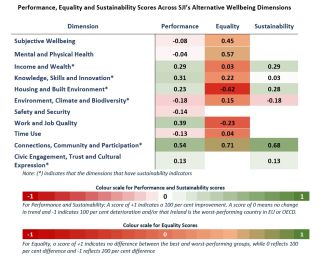
- Performance: Four dimensions – Connections, Community and Participation; Work and Job Quality; Knowledge, Skills and Innovation and Income and Wealth show modest improvements. Two dimensions – Housing and Built Environment (0.23) and Civic Engagement, Trust and Cultural Expression (0.13) – show only marginal progress. However, five dimensions – Subjective Wellbeing; Mental and Physical Health; Environment, Climate and Biodiversity; Safety and Security; and Time Use – show negative performances.
Equality: Disparities exist across all nine dimensions measured for equality. Three dimensions show a relatively smaller gap in inequalities – Connections, Community and Participation (0.71); Mental and Physical Health (0.57); and Subjective Wellbeing (0.45). However, this still reflects a substantial gap between the best- and worst-performing groups. Four dimensions show very large differences, almost 80 to 100 per cent, between the best- and worst-performing groups: Knowledge, Skills and Innovation (0.22); Environment, Climate and Biodiversity (0.15); Time Use (0.04) and Income and Wealth (0.03). While two dimensions: Housing and Built Environment (-0.62); and Work and Job Quality (-0.23) exhibit worsening divides, suggesting a deepening gap between advantaged and disadvantaged groups.
- Sustainability: Performance in sustainability remains marginal across five out of six dimensions tagged for sustainability, except Connections, Community and Participation where performance is noteworthy (0.68). However, this marginal gain is not sufficient to indicate meaningful progress in ensuring long-term resilience. Knowledge, Skills and Innovation (0.03) show little to no progress. Alarmingly, Environment, Climate and Biodiversity (-0.18) show a concerning decline, highlighting ongoing challenges in meeting emissions reduction targets and energy affordability concerns.
What Do These Findings Tell Us and Why We Need a New Approach to Wellbeing?
The results of Social Justice Ireland’s alternative wellbeing framework paint a troubling picture of societal wellbeing. While some areas show modest improvements, substantial disparities persist, and progress in key dimensions remains fragile and uneven. In particular, the lack of focus on equality and sustainability in the Government’s Wellbeing Framework risks presenting an overly optimistic picture that does not accurately reflect the lived realities of many.
Although both frameworks aim to measure wellbeing across multiple dimensions, they differ significantly in the choice of indicators, scoring method, and focus areas, which ultimately present two distinct realities of life in Ireland. As illustrated in the table above, Social Justice Ireland’s alternative wellbeing framework explicitly highlights inequalities that lie behind these averages. These inequalities do not show up in the Government’s dashboard, as the visual summary gives the impression of improvement, while the real gaps are hidden away in the text. Moreover, as with any high-level dashboard, there is a risk of assuming that aggregate improvements mean that life is better for everyone when in reality some groups remain significantly disadvantaged. A wellbeing framework should make these differences visible.
Towards a Fairer Future
The key question is how to effectively improve wellbeing. This is where a comprehensive, coherent policy agenda guided by principles of fairness, sustainability, and the common good would be transformative. The social contract must foster societal wellbeing if it is to last. If it fails to do so, it risks a breakdown in the social fabric and a loss of faith in our democratic institutions. Social Justice Ireland proposes an integrated policy framework for a new social contract that identifies five key policy outcomes, mentioned below, essential to enhancing wellbeing.
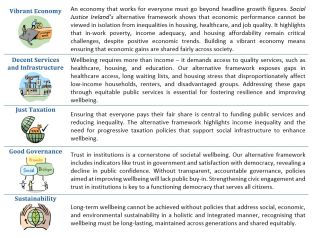
As Ireland continues to embed the Wellbeing Framework in its policymaking processes, it is essential to prioritise equity, inclusion, and long-term sustainability, paving the way for a fairer and more just society.
'Wellbeing: Measuring What Matters 2025' is available to download here.
This project has been part-funded by Coalition 2030, an alliance of 70+ civil society organisations from the international aid, domestic anti-poverty and equality, environment and trade union sectoral pillars working to ensure that Ireland keeps its promise to achieve the Sustainable Development Goals, both at home and abroad.