
Environment, Climate and Energy: Understanding Ireland’s Wellbeing Gap

Ireland’s wellbeing performance in the Environment, Climate and Biodiversity dimension reveals a concerning pattern. Social Justice Ireland's latest wellbeing shadow report show negative trends in both performance (-0.08) and sustainability (-0.08), alongside a low equality score (0.15) with more than 80 per cent inequality. This points to a stark divide in environmental outcomes across different demographic groups and insufficient progress in achieving national and international targets. The dimension also aligns with SDG 7: Affordable and Clean Energy, SDG 11: Sustainable Cities and Communities, SDG 12: Climate Action, and SDG 15: Life on Land and highlight the need for sustainable, equitable solutions.
This dimension captures four critical indicators:
- Access to reliable, affordable and sustainable energy
- Biodiversity loss
- The proportion of the population unable to keep their homes adequately warm
- Greenhouse gas emissions
The figure below presents the performance, equality, and sustainability scores for these key indicators under this dimension, as well as the overall Environment, Climate, and Biodiversity dimension.
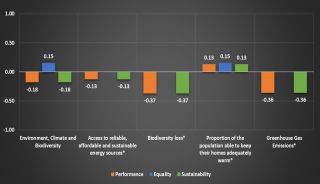
Details of each indicator are provided below, highlighting the specific gaps and challenges within this dimension.
Indicator 1: Access to reliable, affordable and sustainable energy sources
Despite some improvement in the share of renewables during recent years, Ireland’s fuel mix for electricity generation remains heavily dependent on carbon-based fossil fuels. According to the Sustainable Energy Authority of Ireland, in 2023, 40.7 per cent of Ireland’s electricity supply came from renewable energy, down slightly from 42 per cent in 2020. This decline runs contrary to Ireland’s national targets to reduce emissions, increase renewable energy production, and eliminate reliance on fossil fuels. Compounding the challenge, Ireland’s dependency on imported fossil fuels has worsened, rising from 72 per cent in 2020 to 82.6 per cent in 2023. At the European level, Ireland lags significantly behind other countries. In 2023, the EU average share of renewable energy in gross final energy consumption was 24.55 per cent, with the best-performing countries being Sweden (66.4 per cent) and Finland (50.8 per cent). In contrast, Ireland recorded just 15.25 per cent, far below the EU average and slightly by its annual 2030 target of 16 per cent. Looking ahead, Ireland’s overall renewable energy share must rise to 43 per cent by 2030 to meet its ambitious goals. As of 2023, Ireland ranks fourth-last among EU member states for the share of renewable energy in gross final energy consumption. These figures highlight the urgent need for Ireland to accelerate its renewable energy transition.
Indicator 2: Biodiversity loss
In terms of biodiversity, it is interesting to note that Ireland has had the same number of Natura2000 sites (consisting of both Special Protected Areas (SPAs) under the EU Birds Directive and Special Areas of Conservation (SACs) under the EU Habitats Directive) between 2015 and 2020 (923,000 hectares). The common and farmland bird indices both improved between 2017 and 2022. While at a European level, Ireland had the second lowest proportion of Surface of the terrestrial protected areas at 13.9 per cent, which comprised of nationally designated protected areas and Natura 2000 sites (both marine and terrestrial protected areas designated under the EU Habitats and Birds Directives), just ahead of Finland (13.4 per cent) and far below the EU average of 26.1 per cent. The best performing countries are Bulgaria at 41 per cent followed by Slovenia at 40.5 per cent which demonstrate far greater biodiversity protection. Ireland’s low proportion of protected areas highlights a critical gap in addressing biodiversity loss.
Indicator 3: Proportion of the population able to keep their homes adequately warm
While the proportion of the population unable to keep their home adequately warm has decreased considerably to 4.9 per cent in 2024 from 7.2 per cent in 2023, it is nevertheless higher from 3.5 per cent recorded in 2020. Internationally, this places Ireland 16th (sharing its ranking with Belgium, Czechia and Croatia) among EU member states and still performing better than the EU average of 9.2 per cent. Luxembourg (2.1 per cent), Finland (2.7 per cent), Poland and Slovenia (3.3 per cent) lead as the best-performing nations in this category.
Within Ireland, sex differences are minimal, with 4.7 per cent of men and 5.1 per cent of women unable to afford adequate warmth. However, disparities become stark when considering age, economic status, education level, and household composition. Children under 17 are disproportionately affected, with 6.1 per cent living in homes unable to maintain adequate warmth. Economic disparities are more pronounced: 10 per cent of unemployed individuals and 11.4 per cent of those unable to work due to long-standing health problems face this issue, compared to just 3 per cent of retirees and 3.6 per cent of employed individuals. Looking at the education levels of the head of the household, we see similar patterns as seen in income inequality and housing affordability, with 5 per cent of those with lower secondary education and 6.3 per cent of those with primary education or below unable to afford warmth, compared to just 3.1 per cent of those with third-level degrees. Household composition shows that lone-parent households (13 per cent) and single-person households (between 4.6 to 9.4 per cent) are most affected, while households with three or more adults have a much lower rate of 2.2 per cent. Tenure status further reveals that 9.4 per cent of renters or those in rent-free arrangements struggle to afford warmth, compared to just 2.9 per cent of owner-occupied households.
Indicator 4: Greenhouse Gas Emissions
Finally, greenhouse gas emissions present another critical challenge. Between 2019 and 2023, Ireland reduced its greenhouse gas emissions by only 8 per cent, far from the reductions needed to meet climate targets. In terms of international comparability, Ireland’s emissions in 2023 were 11.1 tonnes per capita, the highest among EU member states after Luxembourg (10.6 tonnes per capita) and significantly above the EU average of 6.7 tonnes per capita. Sweden, the best-performing country, recorded just 1.2 tonnes per capita, followed by Romania at 3.0 tonnes per capita. These figures highlight Ireland’s ongoing struggle to reduce emissions and transition to a low-carbon economy.
Despite some progress made in the renewable energy, Ireland continues to lag behind its EU peers in critical areas such as greenhouse gas emissions, renewable energy adoption, and biodiversity protection. The disparities in energy poverty further emphasise the need for inclusive, equitable solutions that prioritise vulnerable populations. This challenge is reinforced by the latest figures from the Commission for Regulation of Utilities, which show that between December 2024 and December 2025, the number of households in arrears on their energy bills has increased by almost 20 per cent.
Addressing these interconnected environmental and social challenges will require bold, sustained policy action and increased investment in sustainable energy and conservation efforts. In its first Introductory Report, the Just Transition Commission, has also called on the Government to urgently develop a bold, nationwide strategy that sets out how Ireland’s approach to climate action will ensure a fair and inclusive transition to a climate-neutral society, one that delivers benefits for all, especially those most vulnerable to the transition. The Commission report notes that this is our chance to embrace just transition as the foundation for a fairer, more resilient Ireland; one that delivers for people and the planet. We have an opportunity and a responsibility to look beyond emissions and to deliver an approach to climate action that will uplift and protect communities, enhance lives and leave no one or no place behind.
Read Social Justice Ireland's report Wellbeing: Measuring What Matters 2025 Edition here and you can download the Introductory Report of the Just Transition Commission of Ireland 2025 here.