Cost of Living - Time for Budget 2027 to Address Income Adequacy

Since 2022, Ireland has experienced a series of energy shocks, resulting in a prolonged spike in energy prices and subsequent knock-on impacts for households and businesses. This has led to a sustained increase in energy and food inflation over this period, eroding income gains for low and middle-income households, reducing their purchasing power. When considering measures to address cost of living pressures in Budget 2027, Government must deliver investment in social infrastructure, develop a broad and stable tax base, and prioritise the protection of vulnerable groups if it is to deliver on its commitment to deliver progressive budgets.
The current cost of living and energy crisis has made the challenge of making ends meet a feature of the day-to-day life for many households across Irish society and across much of the income distribution. Households on the lowest incomes, through good and bad economic times, struggle to live life on a low income. The most recent CSO SILC data shows that 12.6 per cent of the population were at risk of poverty in 2025.
Without temporary cost of living measures, 14.9 per cent of the population (an additional 125,548 people) would have been living in poverty. Short-term transfers masked a shift towards greater poverty levels in 2025, as in 2023 and 2024, particularly among older people. The SILC data points to the long term economic and social impact of rising prices on households on the lowest incomes CSO SILC Deprivation data shows that more than one third of households experiencing deprivation were in arrears on utility bills, one in three single adult households with children were in arrears on utility bills; and three in ten (31 per cent) single-adult households with children went into debt to meet ordinary living expenses.
This gives an insight into the prolonged impact of cost of living pressures on low income households. The impact of inflation is greatest for those households in the bottom four deciles of the income distribution. These households are very exposed to the nature of the current cost-of-living crisis as they spend a greater proportion of their income on food and energy.
As inflation persists, policy will need to more impactfully target these households and further assist with the growing living cost challenges they face. Sustained action is required to support vulnerable households who can’t afford the basics, and a long-term approach to the persistent problem of households who are unable to make ends meet is required.
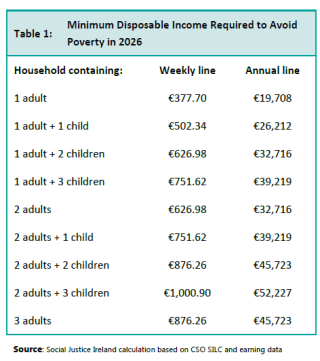
Decisions around measures to address the rising cost of energy and the knock on impact on the cost of living must be focused on income adequacy and improving the situation of those who are most impacted by the rising costs. That should begin with an immediate commitment to benchmark core social welfare rates to average earnings. As the data shows, although one-off measures provided temporary relief to some households, they are not an adequate response to persistent challenges with poverty and inadequate income.
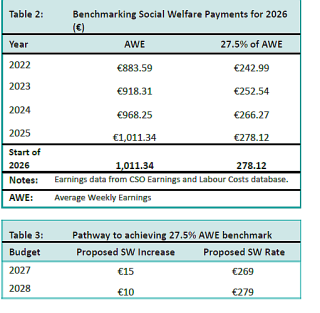
Cost of living challenges are an issue of adequate income. Households on fixed or low incomes are already fully stretched financially and have endured almost four years of increased costs in the basics – food, energy and housing. Adequate levels of social welfare are essential; Budget 2027 should set out a pathway to indexation, commencing with a benchmark to 27.5 per cent of average weekly earnings. Table 3 sets out how this could be achieved over two budgets, in line with Actions 39 and 40 of the new Roadmap for Social Inclusion 2026-2030.