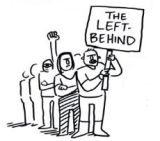
Economic recovery has yet to be experienced by large numbers of people in Europe. Many remain excluded as they continue to lose out in employment, education, healthcare, poverty and related services. This is undermining the confidence many people had in the European project because they see the EU constantly giving priority to economic issues ahead of social challenges.
'Europe: The Excluded Suffer while Europe Stagnates’ is the tenth publication in Social Justice Ireland’s European Research Series. The report reviews the social situation in the 28
The executive summary of Social Justice Ireland's Socio-Economic Review 2017 'A New Social Contract for a New Century' is available below.
There will be nearly 1 million people aged 65 and over by 2031 – an increase of 86.4 per cent. Of these 136,000 will be aged 85 or over by 2031, an increase of 132.8 per cent. Now is the time to plan Ireland’s investment in services and infrastructure. This is one of the key issues highlighted in the National Social Monitor 2016.
The National Social Monitor is Social Justice Ireland’s annual contribution to the public debate that is needed on Ireland’s future and how Ireland is performing in terms of promoting the
A brief snapshot on how Ireland is performing in terms of healthcare and some policy proposals.
Social Justice Ireland today (April 4, 2016) presents its latest EU-wide study to the EU's Economic and Social Committee (EESC) in Brussels. Entitled 'Europe: A Union for the Powerless as well as the Powerful' it analyses what has been happening in all 28 EU countries on issues such as poverty, unemployment, services and taxation.
The next Programme for Government should be focused on delivering five key outcomes: a vibrant economy, decent services and infrastructure, just taxation, good governance and sustainability. Each of these is essential if Ireland is to have a fairer future. These five areas of policy need to be addressed urgently if Ireland is to move towards being a society characterised by solidarity and fairness. They form the core of Social Justice Ireland’s proposed framework for the next Programme for Government.
Social Justice Ireland's policy briefing ' A Proposed Policy Framework for the Government of the 32nd Dáil' is available below.
Ireland has been through many “boom-Bust” economic cycles. Each “bust” has led to assurances that lessons have been learned and that changes will be made to ensure that the next recovery will be sustainable. Election 2016 occurs at the cusp of such discussions and offers us an opportunity to vote for policies which can indeed break the “boom-bust” cycle and deliver a more stable future. Real sustainability will require a long term vision and a capacity to develop and implement policies which will have their impact in 10 or even 20 years’ time.