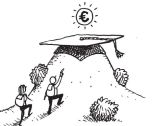
This section of our National Social Monitor Autumn 2018 provides a brief insight into the difficulties in our Education and Childcare sectors, analysing Ireland's education expenditure and th
With 10,000 people - including 3,600 children - homeless, 72,000 mortgages in arrears, and 86,000 households on social housing waiting lists, it can hardly be denied that Government policy is a dramatic failure.
The Government has today published its National Reform Programme 2018, as submitted to the European Commission. In informing this process Social Justice Ireland submitted two papers to the Department of An Taoiseach - our comprehensive Europe2020 report and our analysis on the Country Specific Recommendations set out in the 2018 Country Report for Ireland.
While the economy is doing well, it is crucial that policy-makers realise that many on lower incomes are not benefiting as they should. Almost 800,000 people in Ireland are living in poverty, a quarter of a million of whom are children. 1 million people in Ireland are experiencing deprivation. 105,000 people are working in a job with income so low they are living in poverty. Social Justice Ireland has a plan to fix this, and to build a fairer society for all.
International Literacy Day (8 September) will be celebrated across the world under the theme of ‘Literacy in a digital world’. The overall aim to look at what kind of literacy skills people need to navigate increasingly digitally-mediated societies, and to explore effective literacy policies and programmes that can leverage the opportunities that the digital world provides. Literacy in a digital world is a key target in Sustainable Development Goal 4.
The National Social Monitor is Social Justice Ireland’s annual contribution to the public debate that is needed on Ireland’s future and how Ireland is performing in terms of promoting the wellbeing of all in society. It examines progress in areas such as housing, healthcare, education, employment, rural development and the environment among others.
Ireland’s social contract is broken. The legitimate expectations of citizens are not being met. This is most obvious in areas such as housing and homelessness, a two-tier healthcare system, an ongoing failure to provide rural broadband and high levels of poverty and social exclusion, especially among children. 2017 is the first year of a new century for Ireland and now is the perfect opportunity to develop a new and radical social contract for Ireland’s second century.
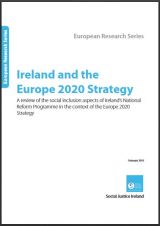
Social Justice Ireland has published its annual review of the social inclusion aspects of Ireland's National Reform Programme and the Europe 2020 Strategy. The review examines I
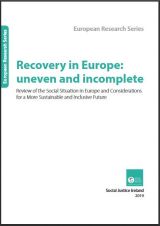
Economic recovery has yet to be experienced by large numbers of people in Europe. Many remain excluded as they continue to lose out in employment, education, healthcare, poverty and related services. This is undermining the confidence many people had in the European project because they see the EU constantly giving priority to economic issues ahead of social challenges.
'Europe: The Excluded Suffer while Europe Stagnates’ is the tenth publication in Social Justice Ireland’s European Research Series. The report reviews the social situation in the 28