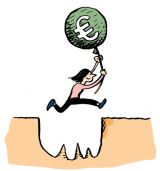
The issue of child poverty is again prominent in the European Commission agenda, with the publication of the Council Recommendation for Establishing a European Child Guarantee. In order to be successful, increased political focus is required and children must be at the heart of post-Covid recovery plans. Increased European and national funding is also a prerequisite for success.
The Government’s Stability Programme Update raises major challenges for Ireland on debt, infrastructure, taxation and services. Social Justice Ireland believes a new approach is required if these challenges are to be addressed effectively.
Before we had ever heard of Covid-19, Ireland faced a number of significant challenges. Among the biggest were those posed by inequality. Policymakers must acknowledge that a thriving economy is not a goal in itself but a means to social development and wellbeing for all.
In its annual Socio-Economic Review Social Justice Ireland argues that fundamental changes are required if Ireland is to have a fair recovery post-pandemic. Returning to pre-Covid normal would mean failure. A new Social Contract is needed and it can be developed and delivered.
A recent publication by the Government’s own Parliamentary Budget Office provides an analytical model for public debt sustainability and shows, without debt consolidation or spending cuts, Ireland’s debt to income ratio over the next decade will be on a downward trajectory.
Social Justice Ireland's submission to the public consultation on the National Recovery and Resilience Plan. Social Justice Ireland's submission to the public consultation on the…
In this socio-economic review for 2021 Social Justice Ireland presents a detailed analysis of a range of key matters which are central to social justice; a vision of Ireland’s…
The past fifty years has been a period of falling taxes on the rich in developed economies. A report by the London School of Economics and Political Science has found that reducing taxes on the rich leads to higher income inequality and has little or no impact on economic growth or unemployment. The report finds major tax cuts for the rich since the 1980s have increased income inequality without any offsetting gains in economic performance. It concludes that governments seeking to restore public finances following the COVID-19 crisis should therefore not be concerned about the economic consequences of higher taxes on the rich.
A recent Oxfam report, published for the opening day of the World Economic Forum, reveals that the world’s 10 richest men saw their wealth increase by half a trillion dollars during the pandemic, while the 1,000 richest people on the planet recouped their Covid-19 losses within just nine months.
At the European level, what the pandemic has cast doubt on is the very fundamentals of European integration. The main features of the European Union, what could be described as its “pillars”, are these: the single market and freedom of movement, the euro and the Stability and Growth Pact, and competition and state-aid law. We can already look ahead and see that the post-crisis EU could be standing on very different foundations if the questioning of the three basic pillars continues over time or, conversely, it could just as easily go back to its old ways. What will the world environment in which this happens be, though? Here there are four possible scenarios emerging.