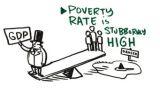
With 800,000 people in poverty, record numbers on healthcare waiting lists and more than 3,800 children homeless, Ireland is a profoundly unequal place. Inequality hurts the economy, leading to unstable economic growth and employment, higher debt, housing bubbles and increased homelessness. Substantial evidence has emerged in recent years to support the view that economies and societies perform better across a number of different metrics, from better health to lower crime rates, where there is less inequality.
Some Reflections on Inequality in Ireland’ is part of Social Justice Ireland’s Policy Research Series. It reflects on the reality of equality and the myths that enable its persistence. It looks at inequality in economics and the ideologies in public policy that have produced the present unequal situation across the world.
In this section of our National Social Monitor Autumn 2018 we look at income distribution patterns, the widening gap of income migration and poverty and propose a number of policy priorities to tac
With 10,000 people - including 3,600 children - homeless, 72,000 mortgages in arrears, and 86,000 households on social housing waiting lists, it can hardly be denied that Government policy is a dramatic failure.
Ireland now has the resources to ensure that inequality can be tackled effectively and the linked social injustices of poverty, waiting lists and homelessness can be addressed. Priority should be given to reducing poverty, tackling the social housing crisis and reforming the healthcare system in both urban and rural Ireland. Following on from our annual Sustainable Progress Index, Social Justice Ireland has published a 4-page brief on Ireland’s inability to get to grips with inequality.
The Living Wage for 2018 has been set at €11.90 per hour; an inrease of 20c over the last year. With the cost of living in most other areas falling, this increase is being driven solely by rising accommodation costs, with rent now accounting for half of minimum living costs in Dublin.
With significant resources available in Budget 2019, it is time to address an unjustifiable discrimination against younger people. The rate of severe deprivation among 18-24 year olds increased twice as fast as it did for the general population between 2007 and 2015. Removing the tiered approach to Jobseekers Allowance would help to reverse this.
Social Justice Ireland strongly welcomes Minister Regina Doherty’s comments this week, saying she believes in the universality of child benefit payments. Child benefit is an important acknowledgement of the fact that raising children is an economically and socially necessary job.
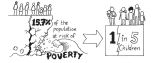
A new study released today by the CSO reminds us that despite our improved economic performance, one in six Irish people are still living in poverty.
The Government has today published its National Reform Programme 2018, as submitted to the European Commission. In informing this process Social Justice Ireland submitted two papers to the Department of An Taoiseach - our comprehensive Europe2020 report and our analysis on the Country Specific Recommendations set out in the 2018 Country Report for Ireland.