Brexit has the potential to even further reduce the living standards of Ireland's most vulenerable. A sudden increase in food prices will hit lower income households hardest. Here's why.
Low pay is a big problem for Irish society. As we have continuously pointed out, that that more than 100,000 people in Ireland who have a paid job are living in poverty. These are the “working poor”. The best way to ensure that people working full-time can earn enough to afford a decent standard of living is to move the Minimum Wage closer to the Living Wage.
International Basic Income Week 2019 runs from the 16th of September to the 22nd. Social Justice Ireland has long been one of Ireland's leading proponents of Basic Income. This article contains links to a number of papers and videos on the subject of Basic Income, many of which were presented at our 2016 Social Policy Conference which was centred around the topic.
Pension-related tax reliefs are an expensive means of subsidising retirement savings for the better off, with little financial benefit to the State. The current system has a very high fiscal cost, yet is currently failing to meet its targets in relation to coverage and income adequacy. In this article, we show that the arguments in favour of continuing this perverse incentive system do not stack up. There is no fiscal benefit to the exchequer in either the short or the long term.
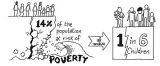
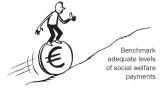
Adequate social welfare payments are required to prevent and address poverty. Without the social welfare system 43.8 per cent of the Irish population would have been living in poverty in 2017. In order to keep pace with earnings growth, social welfare rates should increase by €9 per week in Budget 2020.
Investment in Children and Families is an essential investment in our social and human capital now and into the future. Our Budget 2020 submission contains a number of costed proposals in this area.
The Irish Pension system is in need of significant reform. Unfortunately policymakers have limited the scope of this reform to introducing Automatic Enrolment and very little else. In any format and by any measure, Auto Enrolment will greatly increase the (already significant) cost to the Exchequer of a private system that is failing to achieve its goals.A forthcoming conference, organised by the Pension Policy Research Group, will look at aspects of Auto Enrolment and the implications for the Irish pension system.
Social Justice Ireland wishes our newly elected MEPs every success. This is a pivotal time for the future of the European Union and MEPs play a key role in ensuring that social and environmental sustainability and the Sustainable Development Goals are at the heart of Europe's future. To this end we have formulated Five Key Policy Asks for our MEPs in conjunction with Trocaire. They are: The Elimination of Poverty The Championing of Climate Justice Policy Coherence on the SDGs Delivery on the European Pillar of Social Rights Supporting an international treaty on Business and Human Rights
Defined as a set of conditions where “individuals or households are not able to adequately heat or provide other required energy services in their homes at affordable cost”, energy poverty affects almost 50 million people in the European Union, according to a recent report from the European Energy Network. In Ireland, the number of people who went without heat due to financial constraints in 2017 was almost 393,417 (CSO SILC, 2018). Data released by Eurostat this week (21st May 2019) show that Ireland had the highest increase in gas prices and the fifth highest increase in electricity prices in the EU. Without adequate measures to tackle the causes of fuel poverty, what next for families going without this basic necessity?
In this edition of our National Social Monitor, Social Justice Ireland looks at the budgets of each of the 31 Local Authorities and analyses where the money was spent, and where it wasn’t, to assess the priorities of local government.