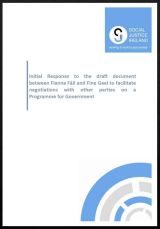
In the first quarter of each year the European Commission release its Country Report for Ireland, detailing its review of the current economic situation, Ireland’s progress with country-specific recommendations previously made by the European Commission, and setting out reform priorities for Ireland in the coming year. In our initial response to this year’s report, Social Justice Ireland welcomed the focus on a number of key areas and set out our proposals on how Ireland might respond to the Country Specific Recommendations.
Access to justice is a basic human right, however in order to achieve equality of access, there must be a balance of power on both sides. In a legal context, the balance of power almost always rests with those who can afford counsel. Redressing this balance requires the availability of free and low-cost legal services to those who need the advice of a qualified solicitor or barrister but who cannot afford the costs associated with it.
Libraries provide an important social outlet and educational role in Ireland, with 17.2 million visits recorded in 2016 by 754,748 members across 330 branch libraries and 31 mobile libraries. Operated by Local Authorities, they play an important role in ensuring access to information, reading and learning material.
An outline of the policy challenges relating to Public Services and our proposed policy response is contained in Social Justice Matters: 2019 guide to a Fairer Irish Society. The chapter
700,000 on healthcare waiting lists, 500,000 homes without broadband, over 11,000 people homeless – a result of Government policy failing to tackle causes - Social Justice Ireland publishes National Social Monitor Winter 2018.
In order to improve the wellbeing of everyone in society, at all stages of the life cycle, it is vital that our policies address the causes of problems rather than their symptoms only. It is through this lens that Social Justice Ireland examines the ten policy areas in the National Social Monitor.
With 10,000 people - including 3,600 children - homeless, 72,000 mortgages in arrears, and 86,000 households on social housing waiting lists, it can hardly be denied that Government policy is a dramatic failure.
The Central Bank of Ireland is currently formulating its Strategic Plan 2019-2021. In light of the number of regulatory issues coming to light - with tracker mortgages, over-charging and access issues - it is important that this Strategic Plan focus on consumer protection and regulation of the financial sector to ensure accountability and access to essential services. See Social Justice Ireland's submission to the Central Bank here.
The Government has today published its National Reform Programme 2018, as submitted to the European Commission. In informing this process Social Justice Ireland submitted two papers to the Department of An Taoiseach - our comprehensive Europe2020 report and our analysis on the Country Specific Recommendations set out in the 2018 Country Report for Ireland.
Successive Governments have continued to look to private entities to deliver public services. This has given rise to a regulatory emphasis on safeguarding competition rather than protecting the consumer, leaving households dependent on essential services at the mercy of market forces. The recommendations in a recent OECD report provide salutary advice.