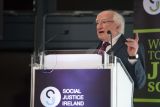
Professor Seán Ó'Riain's presentation at the Social Policy Conference 2014 is available to view. Click the 'read more' link below to watch a larger video or to download the full text of the presentation.
By 2025 the number of people living in Ireland aged over 85 years will have doubled. One clear implication of this will be additional demand for healthcare services and facilities. This is just one of many examples highlighted in Social Justice Ireland's National Social Monitor 2014 which highlight the need for longer-term planning by Government if Ireland is to promote the common good and ensure the wellbeing of its growing population.
The National Social Monitor 2014 outlines the present situation on a range of policy issues that impact on people’s well-being. Social Justice Ireland presents the National Social Mo
Social Justice Ireland's Socio Economic Review 2014 'Steps Towards a Fairer Future' is a 320-page Review which analyses the economic challenges facing Iris
The key focus of the local and European elections should be securing the wellbeing of this and future generations. Social Justice Ireland’s policy briefing ‘Elections 2014’ identifies some key issues and actions required that are critical to shaping a fairer future.
Dr Brigitte Unger director of the WSI (Economic and Social Institute) presented a paper at Social Justice Ireland’s Social Policy Conference 2013 entitled ‘Towards a Social Europe’.
Ireland needs a combination of vision and pragmatic policies that can truly move the country towards a desirable and sustainable future. We need to focus on evidence rather than on the endless assertions we hear communication each day seeking to defend dubious policy developments.
Social Justice Ireland has just published its annual review of the social inclusion aspects of Ireland's National Reform Programme and the Europe 2020 Strategy. The review examines I
Social Justice Ireland welcomes the fact that the European Parliament's Committee on Economic and Monetary Affairs:
783 million people live without clean water, 2.5 billion have no adequate sanitation and 1.4 billion people are without access to electricity in our world today. This is a profoundly unjust s