The National Social Monitor 2015 outlines the present situation on a range of policy issues that impact on people’s well-being. Social Justice Ireland presents the National Social Mo
The Government’s Spring Statement is unfair, contradictory and disappointing. It lacks a clear guiding vision of where Ireland should be by 2020. It also lacks clear policy commitments
Social Justice Ireland's Response to the Government's Spring Economic Statement 2015 may be accessed here.
Click here to download the references contained in 'Choices for Equity and Sustainability' our Socio-Economic Review 2016.
European Commission publication on making the best use of flexibility within the existing Stability and Growth Pact rules.
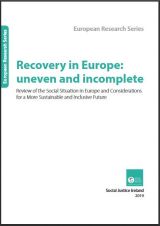
Austerity policies in the EU have contributed to intense economic suffering, particularly for young people and other vulnerable social groups, a new report has found. 123 million EU citizens – one in every four – are at risk of poverty or social exclusion – an increase of 7 million in the six years up to 2013. An extra 8.4 million people became unemployed in the same period and almost one quarter of economically active young people in the EU are unemployed. Young people constitute the largest group in the EU that is underemployed and feels discouraged in looking for work.
The following article by Professor James K. Galbraith appeared in Social Europe Journal on 23 February 2015 and challenges the analysis which has been communicated across mainstream media for several days.
This article first appeared here on the Project Syndicate site. It was written by Joseph E. Stiglitz, a Nobel laureate in economics. What is needed is not structural reform within Greece and Spain so much as structural reform of the Eurozone and a fundamental rethinking of the policy frameworks that have resulted in the monetary union’s spectacularly bad performance. Failure to restructure Greece's debt would be a failure of democracy and morality.
The Irish State should play a greater role in industrial development, basing its decisions on skilful evidence-based analysis and deeper democratic participation, speakers stated in a round-table discussion at Social Justice Ireland’s 2014 Policy Conference.
The OECD and the Irish Fiscal Advisory Council have both published reports outlining the significant challenges ahead for Ireland and Europe in terms of economic recovery. The publication of these reports reinforces the need for long-term planning to be at the heart of policy making in order to deliver the services and infrastructure that will be required in the years ahead.