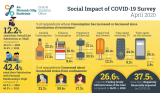
Last week, the CSO published the Live Register data, showing 513,350 people in receipt of some form of welfare support. An estimated 492,000 workers in Ireland may lose thier jobs due to the COVID-19 pandemic alone. Approximately one in five of all employed. The worst affected sectors are retail, hospitality, recreation, non-essential manufacturing and construction sectors. Many of these jobs are defined by instances of low-pay and precarity. Short-term income supports are welcome as we get through this crisis, however long-term measures are required to sustain these sectors.
The Central Statistics Office (CSO) today published data in respect of the Live Register showing a combined total of 513,350 for those on the Live Register and those in receipt of COVID-19 Related Payments. While over half of these people are in receipt of the COVID-19 payments, there is a significant rise in those on the Live Register (and not in receipt of a COVID-19 Related Payment) for less than one year. This highlights the need to provide Decent Work as a key tenet of any new Social Contract and the need to recognise that the term "work" is not synonymous with a job.
As we face into the most difficult and challenging times most of us have ever known, it is important to acknowledge that despite well documented problems and challenges, Ireland is in the privileged position of having public services and social infrastructure to rely on at a time of crisis. In the coming months, when we begin to think of the future beyond the current crisis, we need to consider how we can deliver a social contract to meet our needs in changing times?
The European Union faces many challenges in relation to healthcare, cost of housing and financial distress that will be further exacerbated by the Covid-19 pandemic. This is one of the key findings from the National Social Monitor – European Edition. In this Spring 2020 edition of our National Social Monitor, Social Justice Ireland outlines the present situation on a range of policy issues, comparative to the rest of Europe, that impact on people’s wellbeing and looks at what policies can be introduced to support the most vulnerable.
Irish workers experience one of the highest proportions of low pay in the OECD. Ireland's rate is more than 5 times higher than that of Belgium, the best performer, and only the United States has a worse instance of low paid employment.
Social justice matters. That is why Social Justice Ireland publishes our annual socio-economic review. This book is about charting a course to a fairer Ireland. At the foundation of that is what…
Social Justice Ireland believes strongly in the importance of developing a rights-based approach to social, economic, environmental, and cultural policy. Such an approach would go a long way towards addressing the inequality Ireland has been experiencing and should be at the heart of the development model for a just society. We believe that the next Programme for Government should acknowledge and recognise seven economic, social and cultural rights.
The Government of the 33rd Dáil won’t be able to solve all Ireland's challenges in just five years, but making the right choices can go a long way to delivering a fairer society with a better standard of living for everyone. This is why the next Programme for Government must deliver on five key areas: a vibrant economy, decent services and infrastructure, just taxation, good governance and sustainability.
Ireland's employment performance since the onset of the economic recovery has varied greatly by region. Unsurprisingly, Dublin is the best performer. Other regions fare less well, including the Mid-West (Clare, Tipperary and Limerick). The region has an unemployment rate above the national average, has seen a fall in overall jobs numbers in the last 2 years, and has also seen significant falls in labour force numbers and in participation levels.
Ireland's increased employment and low unemployment rates are occurring in the context of a notably lower participation rate compared to the previous employment peak. Here, we look at some of the participation trends behind the headline numbers.